AI in NP Education: 3 Trends Reshaping How Faculty Prepare Students
- March 17, 2026
Share:
Today’s nurse practitioner students are learning critical thinking in classrooms while artificial intelligence is reshaping clinical practice in real time. Your students will graduate into healthcare settings where algorithms assist with triage, generate documentation, and suggest differential diagnoses. Yet many programs still view AI as a future consideration rather than an immediate competency.
The gap between what you're teaching and what your graduates will face on day one is widening. The question isn't whether to integrate AI into NP education. It's how to do it effectively, ethically, and now.
The Current State: An AI Readiness Gap
Mounting evidence shows that integrating AI systems into healthcare practice can improve efficiency and support decision-making — but only when used by clinicians who understand both their power and their limitations (Wei et al, 2025).
Right now, the difference between AI knowledge attained in education programs and the AI knowledge necessary for practice in healthcare setting is stark. Surveys and qualitative studies show that many new nursing graduates feel underprepared to critically evaluate AI-generated recommendations or to recognize when technology may be introducing bias or error (Abualrahi et al, 2024). This AI readiness gap is as an issue in professional development as well as patient safety.
As healthcare innovation expert Dan Weberg, PhD, MHI, BSN, RN, has observed, an AI divide exists between classroom and clinical practice. The lingering disconnect between educational preparation and clinical reality, Dr. Weberg argues, is a disservice to the nursing profession — and ultimately to patient care.
Closing the Gap: What Actions Should Academic Programs Take?
Academic nursing programs at all degree levels are taking action on this issue, but they cannot match the pace of AI’s rapid-fire evolution. Nor should they. The consensus in the literature is that a combination of measured caution and vigorous pursuit is a wise approach.
As AI literacy becomes an important element of advanced practice nursing, how can academic programs build it in practical ways — and continue to meet increasingly complex education standards?
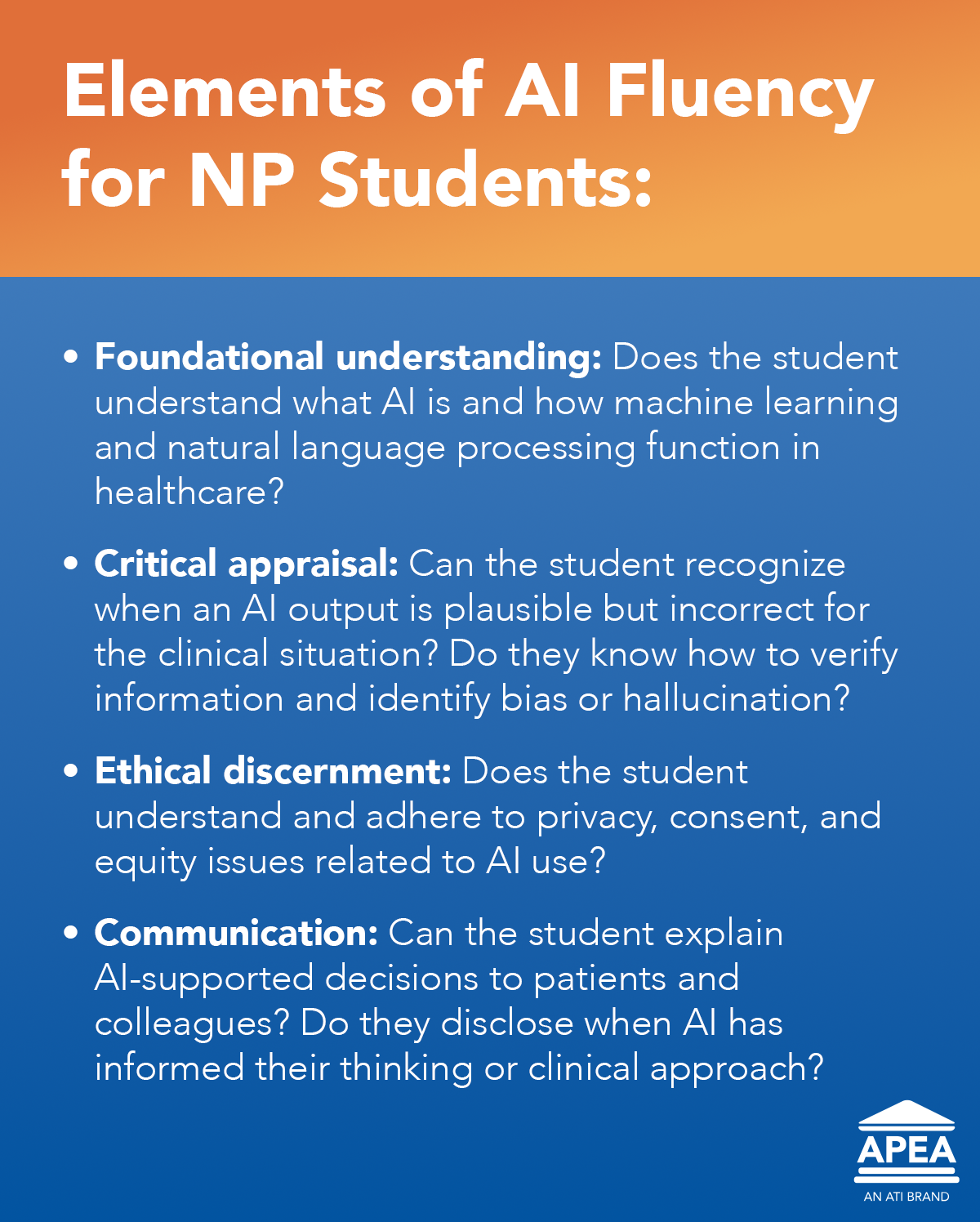
Recent scholarship, including the work of Grace Sun, DNP, APRN, FNP-BC, assistant dean of APRN programs at the University of Texas at Tyler, provides valuable perspective. In an article in the Journal of the American Association of Nurse Practitioners (Sun, 2025), Dr. Sun points out that AI fluency is more than knowing how to use a specific tool. It’s about understanding how AI works, where it can go wrong, and how to integrate its outputs into clinical reasoning without abdicating professional judgment.
“This transition — from conceptual understanding to applied practice — requires a deliberate rethinking of both what we ask students to do and how we as faculty evaluate their work,” Dr. Sun wrote. “In this evolving educational landscape, AI-powered assignments serve as a powerful bridge between theory and practice, offering rich opportunities to foster critical thinking, ethical discernment, and clinical preparedness.”
With appropriate AI learning opportunities, research shows that students in healthcare disciplines can experience benefits including (Kumah, 2025, Cheng & McGregor, 2025, Daniels, 2025, Ghimire & Qiu, 2025):
- improved diagnostic accuracy
- more consistent simulation fidelity
- greater experiential learning
- more personal pathways for learning.
This article explores 3 trends that are reshaping NP education as it integrates artificial intelligence to prepare the next generation of nurse practitioners.
Trend 1. Shifting Emphasis from AI Awareness to AI Fluency
Academic conversations about AI have evolved beyond simply introducing students to AI concepts. More programs now focus on developing what researchers call "AI fluency" — the ability to critically evaluate, effectively collaborate with, and appropriately override AI recommendations. This represents a fundamental shift in education philosophy.
Consider the approach at the University of California-San Francisco, where NP students engage in "AI rounds." They present case studies and then defend decisions to either follow or reject AI-generated clinical recommendations. Students learn to articulate their reasoning, drawing on clinical judgment that appropriately weighs algorithmic outputs.
This pedagogical approach reflects an observation made by Keri L. Draganic, DNP, APRN, ACNP-BC, CNE, in an editorial published in The Nurse Practitioner (Draganic, 2023). She noted that "complex disease management, empathy and compassion cannot be replicated fully by technology."
In another AI fluency-building approach in the University of California system, Mary Gallagher, DNP, MPH, CPNP-PC, an assistant clinical professor in the FNP program at UC-Davis, teamed up with an education technologist to develop a training module in which AI agents provide simulations that students interact with to reach a diagnosis.
“Most of the simulations don’t have to be scheduled around time and space availability,” Dr. Gallagher said, “so this program opens up opportunities. It costs less money and also allows us to be a little more creative in our case offerings.”
In addition to achieving AI fluency applicable to individual patient encounters, NP students must also gain understanding of how AI systems perpetuate or mitigate healthcare disparities (Celi et al, 2022). That’s one reason why healthcare education programs increasingly incorporate modules on algorithmic bias. Students learn to recognize when AI recommendations might source and interpret data that does not serve quality patient care.
Trend 2. Focusing on Faculty as a Key to Success
A significant barrier to AI integration isn't technological — it's human. Faculty acceptance of AI, paired with skill building in AI use, are critical determinants of a program’s ability to prepare graduates who are ready for an AI-supported clinical environment.
The National Organization of Nurse Practitioner Faculties (NONPF) is proactive in this area. Recent initiatives include:
- an Artificial Intelligence Special Interest Group
- a webinar series providing education on topics including AI’s role in aligning NP education with the AACN Essentials, how AI can help prepare new NPs for practice, and how NP faculty can innovate using AI technology
- a position statement in support of telehealth in NP education, noting that AI is integral to telehealth effectiveness.
In terms of institution-generated offerings, a growing number of academic programs are implementing AI mentorship models that pair technology-oriented faculty with clinical experts. This sets the stage for them to codevelop AI-enhanced learning experiences.
In other cases, faculty are thinking outside the box to help students develop AI knowledge. At The Ohio State University, for example, Dr. Weberg and other faculty identify ways to simulate AI interactions even when expensive AI technology resources are limited. By acting as "human AI," instructors deliver both accurate and deliberately flawed recommendations, training students to exercise sound critical thinking regardless of the information source.
Dr. Weberg, who is the executive director of nursing workforce development and innovation at Kaiser Permanente and a clinical assistant professor at The Ohio State University, says this approach addresses a crucial need: teaching students to view AI as an additional data point.
“Ask them, ‘How did you determine whether this was good or bad information? What experience? What evidence do you have? Does it seem reasonable?’” Weberg said. “You can actually use that evidence-based practice process to assess real-time suggestions from a simulated machine insight. And that alone gets students to stop thinking about AI as the answer and more about another data point to make a decision on.”
He said faculty should model this balanced perspective, demonstrating both enthusiasm for AI's capabilities and healthy skepticism about its limitations. In fact, within the growing nursing literature focused on AI, authors are urging educators to reframe their role to develop the professional judgment that is necessary in AI-enhanced practice settings (Sun, 2025, Mahmoudi & Moradi, 2024, Ramadan et al, 2024).
Trend 3. Rethinking Assessments & Academic Integrity in the Age of AI
The intersection of AI and academic integrity is also prompting new thinking. Rather than viewing AI as a threat, some programs are framing it as an opportunity to teach professional ethics.
The International Center for Academic Integrity's 6 fundamental values — honesty, trust, fairness, respect, responsibility, and courage — can provide a framework for AI integration. Strategies to instill academic integrity alongside AI use include:
- early and frequent discussions about appropriate AI use
- clear policies distinguishing between AI assistance and AI substitution
- assignments requiring AI critique rather than AI generation
- portfolio assessments documenting learning progression with AI tools.
But this is only one part of the picture. It’s also true that the integration of AI into education settings of all types and levels has sounded alarm bells about academic dishonesty and cheating. This is prompting faculty and learning institutions to reevaluate traditional assessment methods. Rather than focusing solely on preventing AI-assisted cheating, some programs are redesigning assessments to make AI part of the experience.
For example, some healthcare education programs have implemented “authentic assessments” that are powered by AI (Dolbin et al, 2024). In these assessments, students must document their AI usage, explain their verification processes, and justify their final clinical decisions.
This approach has been endorsed by some academic integrity experts and has been used in medical education (Khakpaki, 2025). The view is that it helps reverse engineer potential cheating tools into learning opportunities.
Alongside strategies such as AI-powered assessments, the emergence of oral examinations, clinical simulations, and real-time case discussions reflects a broader trend toward methods that evaluate judgment and reasoning — competencies that remain distinctly human. These assessment types ask students not just what they know, but how they think. This is particularly useful when AI provides conflicting or ambiguous guidance.
The Path Forward
The integration of AI into NP education is no longer optional. It is essential for preparing practice-ready graduates. Evidence shows that AI-enhanced education can improve learning outcomes, increase efficiency, and better prepare students for contemporary practice.
But successful integration requires more than technology adoption. It demands pedagogical innovation, faculty development, and careful attention to ethics and equity.
As Dr. Sun notes, “By proactively engaging with these challenges, NP educators can prepare students not only to adapt to the changing landscape of health care but also to shape its future with competence, clarity, and care.”
APEA: Your Partner for Improving Program Outcomes
As the integration of artificial intelligence in NP education evolves, APEA remains your proven source of support and evidence-based resources. For 20+ years, we’ve collaborated with faculty nationwide to address learning and evaluation needs, build critical thinking, develop and measure competencies, and reliably predict certification success.
As your program navigates the complexities of AI and other innovations, count on APEA to be a steadfast ally — providing resources, insights, and actionable strategies every step of the way. Together, we can ensure graduates are ready for whatever comes next.
Email requestinfo@apea.com to learn more about faculty and program solutions from APEA.
References
Abualrahi A, Habobi S, Almutar S, Al-Khwaildi F, Alalq M, Bomurah R, Abdrabalnabi Z, Al-Habib E, Al-Mahdi F, Al-Sadah F. Paradigm shift: A systematic review of integrating artificial intelligence in nursing education. American Journal of Nursing Research. 2024;12(3):50-56. https://doi.org/10.12691/ajnr-12-3-2
Celi LA, Cellini J, Charpignon ML, Dee EC, Dernoncourt F, Eber R, Mitchell WG, Moukheiber L, Schirmer J, Situ J, Paguio J, Wawira JG, Yao S. Sources of Bias in Artificial Intelligence That Perpetuate Healthcare Disparities — A Global Review. PLOS Digital Health. 2022;1(3):e00000022. https://doi.org/10.1371/journal.pdig.0000022
Cheng A, McGregor C. Applications of Artificial Intelligence in Healthcare Simulation: A Model of Thinking. Advances in Simulation. 2025;10(45). https://doi.org/10.1186/s41077-025-00379-7
Daniels Z. The Role of AI and Emerging Technologies in Experiential Learning. In: Transforming the Experiential Classroom. 2025, Palgrave Macmillan, Cham. https://doi.org/10.1007/978-3-031-88165-7_10
Dolbin RJ, Liu Y, Slabbinck R, Stewart RL. AI-Powered Education: Authentic Assessments and Learning. 2024;Nov. https://www.asccc.org/content/ai-powered-education-authentic-assessments-and-learning
Draganic K. Artificial Intelligence: Opportunities and Challenges in NP Education. Guest Editorial. The Nurse Practitioner. 2023;48(4):6. DOI: 10.1097/01.NPR.0000000000000023
Ghimire A, Qiu Y. Redefining Pedagogy with Artificial Intelligence: How Nursing Students are Shaping the Future of Learning. Nurse Education in Practice. 2025;84:104330. https://doi.org/10.1016/j.nepr.2025.104330
Khakpaki A. Advancements in Artificial Intelligence Transforming Medical Education: A Comprehensive Overview. Medical Education Online. 2025;30(1):254807. doi: 10.1080/10872981.2025.2542807
Kumah E. Artificial Intelligence in Healthcare and Its Implications for Patient-Centered Care. Discover Public Health. 2025;22(524). https://doi.org/10.1186/s12982-025-00924-9
Mahmoudi H, Moradi MH. The Progress and Future of Artificial Intelligence in Nursing Care: A Review. The Open Public Health Journal. 2024;17(1):e18749445304699. http://dx.doi.org/10.2174/0118749445304699240416074458
Ramadan OME, Alruwaili MM, Elsehrawy MG, Alanazi S. Facilitators and barriers to AI adoption in nursing practice: A Qualitative Study of Registered Nurses’ Perspectives. BMC Nursing. 2024;23(1):891. https://doi.org/10.1186/s12912-024-02571-y
Sun GH. Integrating Artificial Intelligence Into Nurse Practitioner Education: Strategies for Teaching the Next Generation of Nurse Practitioners. Journal of the American Association of Nurse Practitioners. 2025;37(9):491-499. doi: 10.1097/JXX.0000000000001170
Wei Q, Pan S, Liu X, Hong M, Nong C, Zhang W. The Integration of AI in Nursing: Addressing Current Applications, Challenges, and Future Directions. Frontiers in Medicine. 2025;12:154520. https://doi.org/10.3389/fmed.2025.1545420