Promoting Academic Integrity in NP Education: Going Beyond the Honor Code
- May 28, 2026
Share:
Punishment is a fascinating concept. It isn’t really effective—at least not in the ways we assume it is. Studies show the severity of a punishment has almost no impact on how much it deters bad behavior.¹
So, what does promote integrity? Certainty of detection and clarity of expectations.
That certainty isn’t about punishment. It isn’t about the severity of the consequences. It’s about culture. It’s about structure. It’s about creating an environment united in its stand against whatever behavior is threatening its most essential institutions.
For NP educators and academic leaders, that means cheating, plagiarism, and overall academic dishonesty. These behaviors undermine the integrity of their institutions, and they are directly connected to long-term clinical incompetencies.² Still, the solution isn’t about more punishment—it’s about creating an atmosphere that actively promotes academic integrity.
It's All About Building the Right Environment
From 1882 to 1910, huge portions of the Prussian population were living in poverty, and many of those families were relying on rye for a significant portion of their diet. When scholars examined Prussian crime rates and local rye prices side by side, they noticed something undeniable: crime rates increased every time rye got more expensive or more difficult to find.³
Harvest failure? Crime went up. Trade disruption? Crime went up. Then, when the market stabilized, crime rates inevitably returned to normal. This cycle is called the pressure-crime relationship, and it reveals a lot about how programs should approach academic dishonesty.
Simply put, it’s less about finding the right punishment and more about creating an environment that naturally discourages academic dishonesty.
Detailed honor codes. Clear communication. Thoughtfully designed assessments. These are the “rye prices” of your academic atmosphere. They are the variables that apply positive or negative pressure to your students, and they are the building blocks of a program that promotes academic integrity across the board.
Why Conversations About Cheating Matter So Much
They matter because of the effect academic dishonesty can have on the institution, the individual student, and the industry itself. Cheating can undermine a program’s reputation, erode public trust, and place undue stress on faculty members who feel unequipped to do their job effectively.⁴ This is to say nothing of the downstream risk these failed educational experiences can have for patients and their loved ones.²
This means every NP program and every NP educator needs to have honest conversations about academic dishonesty. These conversations are especially urgent because the “cheating problem” is getting more difficult to contain with each passing year.
Failures in academic integrity are increasingly common.⁵ Digital and online assessments are especially vulnerable to cheating, and many industries’ reliance on high-stakes testing adds its own pressure to the situation. It might not be fair to say that students are definitively cheating more than ever, but the opportunities and motivations to do so are at an all-time high.
In response, security efforts are also evolving. Strategies like online proctoring—and more recently AI proctoring—have become essential components of academic integrity.⁶˒⁷ Highly specialized organizations like APEA can guarantee absolute security because they have the skills and resources to keep that promise. Unfortunately, that simply isn't the case for every testing environment.
Why Cheating Happens in the First Place
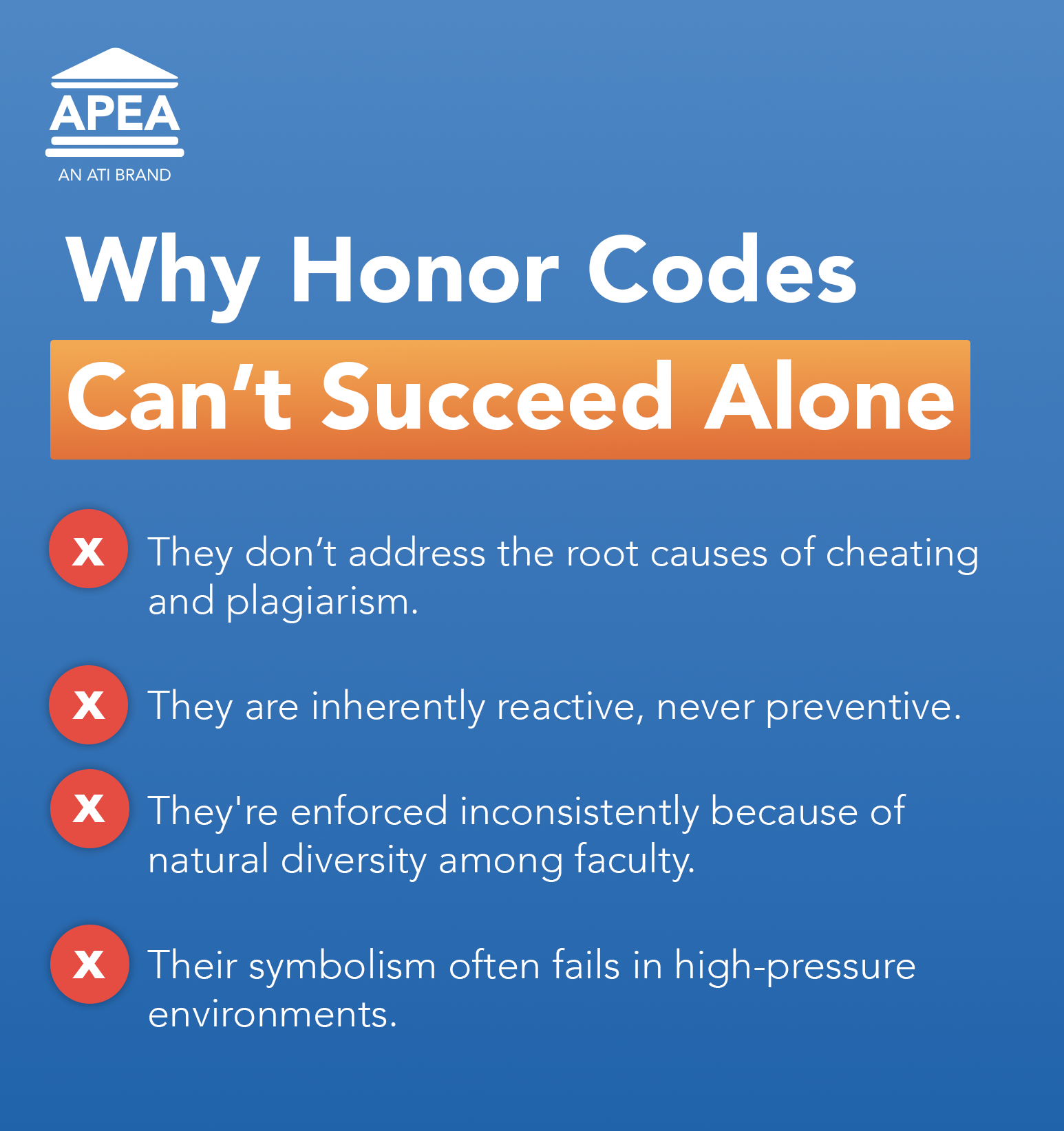
The Prussian panel data shows us that the environment has a direct impact on dishonest behavior. That said, it doesn’t paint a specific picture of what these pressures are like for NP students.
In a recent APEA webinar, Beyond the Honor Code: Academic Integrity, Daniel Hatch, DNP, APRN, FNP‑C, dove much deeper into why cheating is a problem in NP education: “When students feel backed into a corner by high-stakes testing, integrity is often the first casualty.” Of course, high-stakes environments are just the beginning.
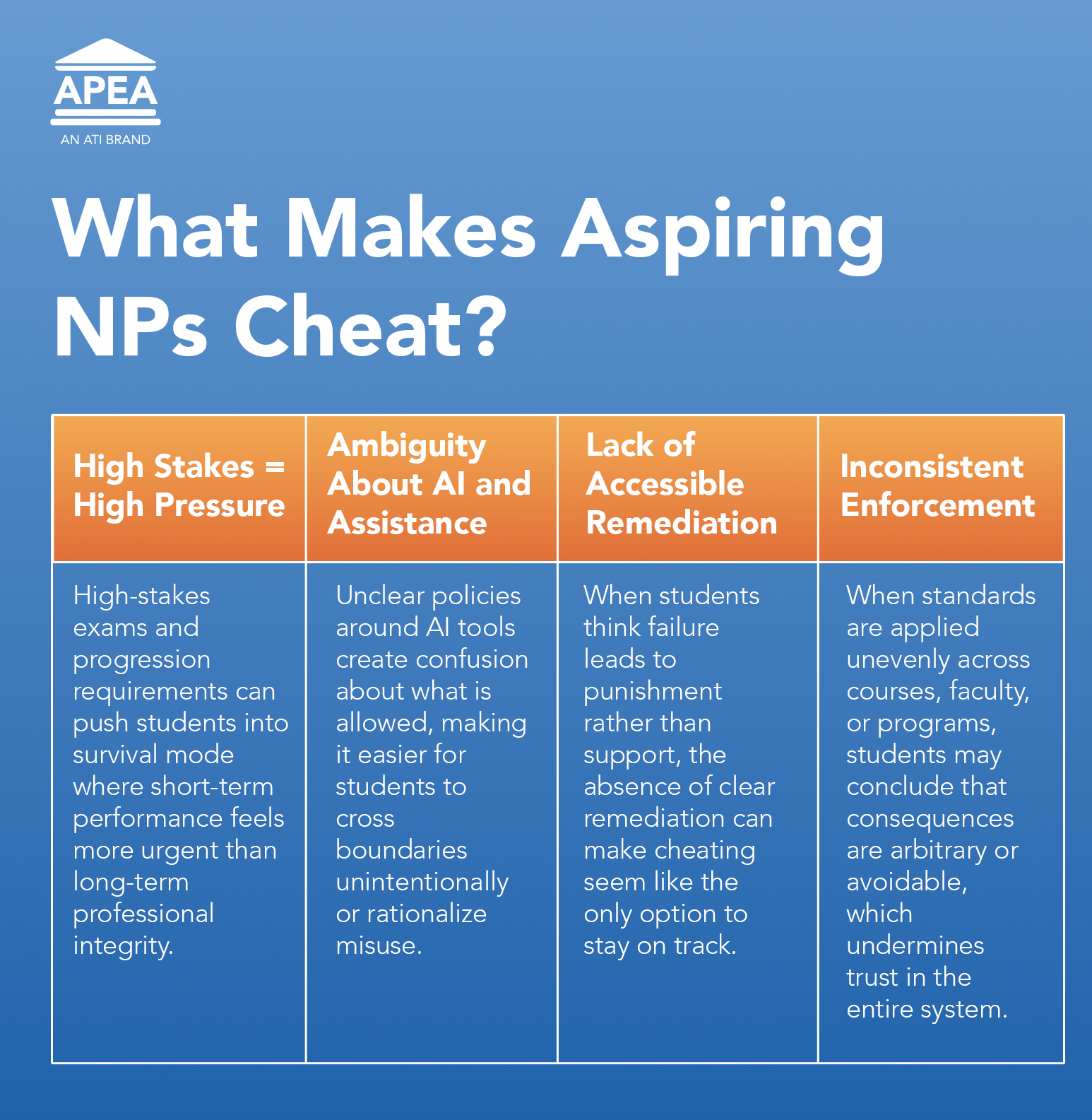
Why Honor Codes Are Never Enough
Honor codes are one of the only components of academic integrity programs that has become an almost-universal standard. Every program has an honor code, and that’s not surprising when you consider how passive and low-maintenance they can be. Unfortunately, honor codes can’t accomplish much on their own—and for good reason:
According to researchers like Tricia Gallant, “traditional approaches such as honor codes and sanctions, while necessary, are insufficient on their own to prevent misconduct.” The alternative is something called the “teaching and learning” approach to academic integrity.⁸ This methodology doesn’t understand cheating and plagiarism as simple rules violations. Instead, it views these breakdowns as a failure of the learning environment itself—the student, the teacher, the structure, the content, etc.
From this perspective, a program's response to academic dishonesty is not limited to punishment or policing. It extends holistically to improving instruction, clarifying expectations, and reevaluating high-stakes pressure. These substantive redesigns of the learning atmosphere are among the only evidence-supported means of reducing academic misconduct at scale.⁹
How Highly Successful Programs Promote Integrity
“Academic integrity isn’t just about catching misconduct—it’s about designing programs that don’t incentivize it.” - Daniel Hatch, APEA integration specialist and NP educator
But what do these programs look like? How are they changing over time? After all, the teaching and learning approach is ultimately just a means of evaluating the situation more comprehensively. It isn’t a detailed list of what to do and how to do it. Those sorts of developments would come in time, and they would be tailored precisely to the program:
- Reduced reliance on high-stakes testing. Progression is no longer anchored to a small set of outcomes, lowering pressure and removing the incentive to cheat.
- Assessments are diagnostic—not punitive. Exams or simulations are treated as tools to identify knowledge gaps and guide learning rather than simply gatekeep progression.
- Multimodal learning demonstrations. Programs rely on multiple forms of verification, including written exams, OSCEs, simulation, and oral validation.
- Standardized and personalized remediation pathways. Clear and customized remediation replaces fractured, slow-to-respond support, meaning more consistency and more fairness.
- Crystal clear ethics and integrity boundaries. Expectations are concrete and communicated in a way that reduces ambiguity and promotes transparency around collaboration, resources, and AI use.
- Integrity framed as a shared responsibility. Faculty should model expectations. Messaging should remain consistent. Accountability should be a naturally reinforced part of the process.
Why This Is Important Beyond the Classroom
Academic integrity in NP education doesn't end at graduation. The habits students develop during training shape how they will practice independently, and professional ethics is a large part of that behavior. Programs that tolerate or inadvertently incentivize misconduct risk graduating clinicians whose competence has never been honestly put to the test.
“In NP education, integrity failures don’t stop at graduation—they follow students into practice.” - Daniel Hatch, APEA integration specialist and NP educator
By contrast, learning environments rooted in integrity reinforce professional accountability from the start. They help ensure that each graduate's exam readiness, clinical judgment, and ethical decision‑making are built on authentic and demonstrated competence. In the long term, this means better NPs and better outcomes for everyone.
How AI Can Accelerate and Enhance Every Solution
When used intentionally, AI can be a robust and active support for academic integrity. It can help identify learning gaps early, personalize remediation pathways, generate low‑stakes, on-the-spot assessments, and provide feedback with no concerns over timeliness or scale.¹⁰ In this role, AI reinforces the honor code and reduces pressure at every possible point.
The critical piece to this puzzle is transparency. Programs that clearly define how AI may be used not only remove ambiguity, but they promote responsible use cases and cultivate cutting-edge proficiencies for the student. In this sense, AI is a tool for learning and verification—not a shortcut around it.
A Leading Partner in Promoting Academic Integrity
Going beyond the honor code isn’t easy. Cultivating a rigorous, yet supportive learning environment is more complex than putting broad concepts onto a piece of paper. It takes intention. It takes insight. It takes whatever tools and technologies are needed to relieve academic pressure and encourage professional behavior from everyone.
Such far-reaching efforts are much more surmountable with the guidance of a trusted partner. Someone who understands the specific demands of NP education. Someone with experience supporting the learning environments of highly successful programs. Someone with the knowhow to effectively integrate AI tools to create a less intimidating educational experience.
That someone is APEA. See what’s possible with the right partnership.
REFERENCES
- Nagin DS. Deterrence in the twenty-first century. Crime and Justice. 2013;42(1):199–263. doi:10.1086/670398
- Papadakis MA, Teherani A, Banach MA, et al. Disciplinary action by medical boards and prior behavior in medical school. New England Journal of Medicine. 2004;353(25):2673–2682. doi:10.1056/NEJMoa052596
- Traxler C, Burhop C. Poverty and crime in nineteenth‑century Germany: a reassessment. Max Planck Institute for Research on Collective Goods Discussion Paper No. 2010/35. https://ideas.repec.org/p/mpg/wpaper/2010_35.html
- Bretag T, Harper R, Burton M, et al. Contract cheating: a survey of Australian university students. Studies in Higher Education. 2019;44(11):1837–1856. doi:10.1080/03075079.2018.1462788
- Noorbehbahani F, Mohammadi A, Aminazadeh M. A systematic review of research on cheating in online exams from 2010 to 2021. Education and Information Technologies. 2022;27(6):8413–8460. doi:10.1007/s10639-022-10927-7
- Kumar L, Verma L. Online proctoring and academic integrity: perceptions and practices. International Journal of Recent Education. 2025;14(9). Accessed May 28, 2026. https://ijre.net/wp-content/uploads/2025/09/IJRE0925400048_Online-Proctoring-and-Academic-Integrity-Perceptions-and-Practices.pdf
- Lee AS, Babenko O, George M, Daniels V. The promises and perils of remote proctoring using artificial intelligence. Canadian Medical Education Journal. 2023;14(2):173-174. doi:10.36834/cmej.74229
- Bertram Gallant T. Academic integrity as a teaching and learning issue: from theory to practice. Theory Into Practice. 2017;56(2):88–94. doi:10.1080/00405841.2017.1308173
- Palazzo DJ, Lee Y, Warnakulasooriya R, Pritchard DE. Patterns, correlates, and reduction of homework copying. Physical Review Special Topics – Physics Education Research. 2010;6:010104. doi:10.1103/PhysRevSTPER.6.010104
- Zawacki‑Richter O, Marín VI, Bond M, Gouverneur F. Systematic review of research on artificial intelligence applications in higher education: where are the educators? International Journal of Educational Technology in Higher Education. 2019;16:39. doi:10.1186/s41239‑019‑0171‑0