Claire AI® Comes to CareOnPoint: A Smarter Way to Study, Learn, and Practice
- Sept. 4, 2026
Share:
Technology doesn’t create systems of learning. It makes them better.
Libraries have helped people preserve and share knowledge for thousands of years, and they've never stopped evolving. Catalog systems, digitization, text search, and online repositories. These technologies didn't change the value of knowledge. They just made it easier to access, navigate, and apply.
Claire AI® represents a similar evolution for CareOnPoint, APEA’s digital, mobile-friendly version of Hollier’s Clinical Guidelines in Primary Care, and a resource that already goes well beyond the traditional book.
Claire AI is the next evolution.
The evidence-based content remains the same. The trusted clinical guidelines remain the same. What Claire AI changes is how aspiring and practicing NPs interact with the information, as well as the ways they can use it to build understanding, reinforce knowledge, and strengthen clinical reasoning.
Critically, Claire AI does not replace clinical decision making. Evidence-based guidelines provide the framework. AI supports the learning process. It is still the NP who interprets the information and makes the final choice for each patient.
Regardless, students and NPs need the very best learning tools at their disposal. They need a leading healthcare reference with all the enhancements AI has to offer. But before we examine what Claire AI adds to the CareOnPoint experience, let's start with the foundation that made CareOnPoint such a trusted resource for students and clinicians in the first place.
What CareOnPoint Already Offers to NPs
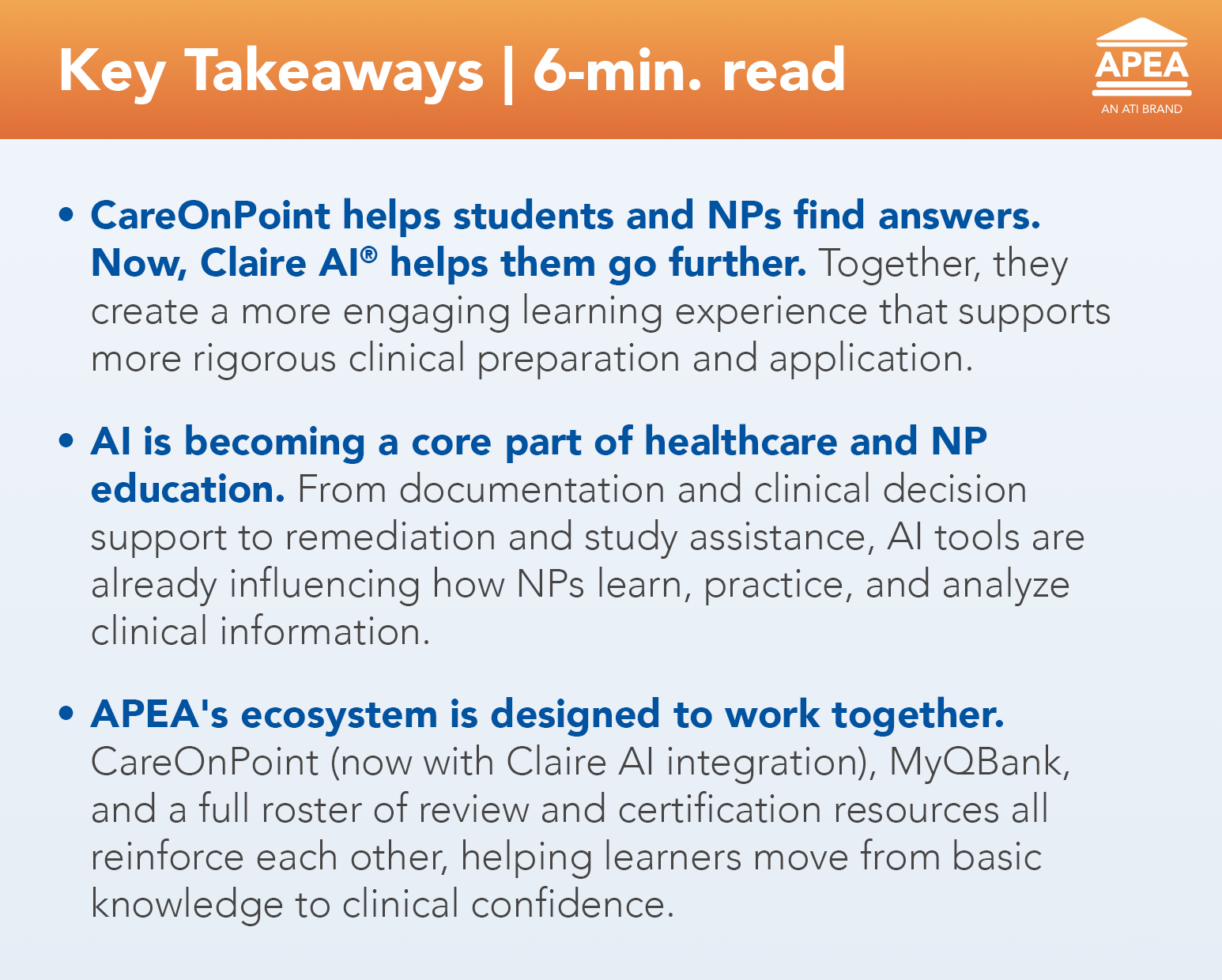
CareOnPoint puts trusted, evidence-based clinical guidance at your fingertips. But CareOnPoint offers more than convenience. In fact, it has several features that make it not just a digital facsimile for Hollier’s Clinical Guidelines in Primary Care, but also an ongoing evolution of the content itself.
- Expanded Content. An ever-growing list of diagnoses, updated as needed.
- Mobile-Friendly Access. Access anywhere on a desktop, tablet or phone.
- Complete Searchability. Search by diagnosis, symptom or body system.
- Open to Updates. Always current with today's clinical guidelines.
- NP-Focused Design. Created specifically for NP education and practice.
Together, these features have helped make CareOnPoint a trusted companion for both NP students and practicing clinicians. Kathy Baldridge, DNP, FNP-BC, APEA’s Lead NP Education Specialist, describes CareOnPoint as a high-value platform throughout the industry.
“It's a very quick, concise clinical resource that clinicians, practicing NPs, and students alike can use to help them with real-world clinical decision-making,” she said. “Users love that it's concise. They know the information is evidence-based, and they know they can rely on it.”
CareOnPoint puts evidence-based clinical guidance within reach. Now, APEA is taking the next step by making that guidance even more interactive, personalized, and accessible through the addition of Claire AI support.
How Claire AI Evolves the Experience
CareOnPoint helps NP students and clinicians find quick answers to their immediate questions. But learning doesn't stop when you find the right answer or flip to the right page. As Dr. Baldridge explains, students often reach a point where they've reviewed the rationale and are left with one remaining question: "But why?"
That's where Claire AI integration makes a major difference. With the introduction of Claire AI support, users can move beyond simply locating information. They can start exploring the clinical reasoning behind that information, filling the knowledge gaps that brought them there in the first place, and building greater confidence in their clinical practice.
Claire AI doesn’t just add to CareOnPoint. It completely changes the way students and clinicians can interact with the platform.
- Follow-up information to deepen understanding. Get the why behind your answers.
- Clarification of difficult concepts in real time. Don't move forward without complete comprehension.
- A direct line from assessment to diagnosis to management. Follow diagnostic logic from start to finish.
- Generate study aids for specific CareOnPoint content. Create personalized remediation tools, including flashcards, quizzes, and mnemonics.
These capabilities transform CareOnPoint from a clinical reference into an active learning experience. Instead of simply locating and digesting information, learners can explore it, question it, reinforce it, and apply it in ways that make it memorable. But what does that look like in practice?
Let's take a closer look at each step of the Claire AI experience inside CareOnPoint.
What Claire AI Support Looks Like
One of the best things about Claire AI integration is how seamlessly it complements the CareOnPoint experience. The Claire AI user interface will look similar to a common chatbot dialogue, utilizing a pop-up window design that is familiar and accessible to almost anyone. It’s an easy, straightforward process that feels like a natural part of the CareOnPoint platform.
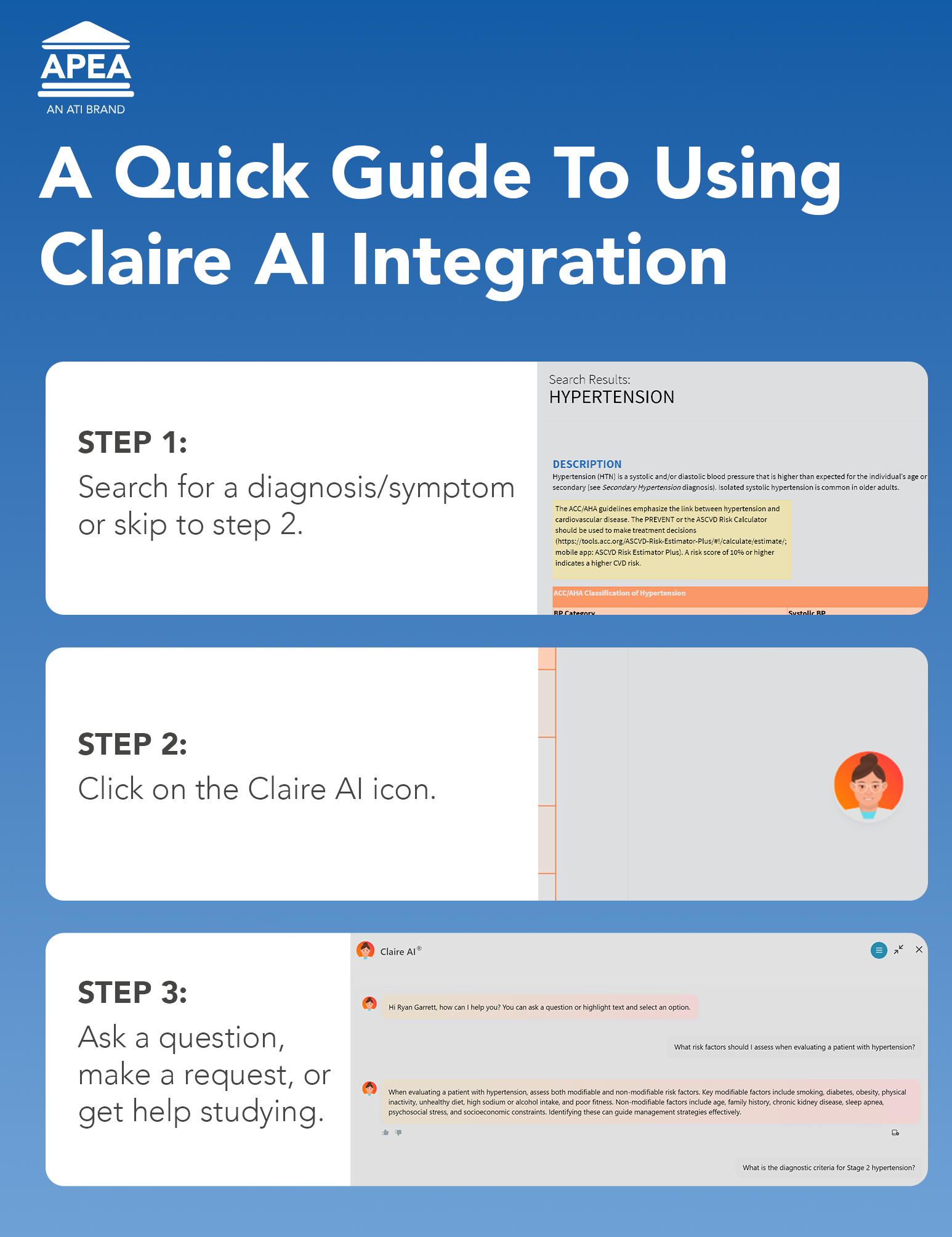
Once you've opened Claire AI, the possibilities are endless. A student or practitioner can ask follow-up questions about a diagnosis, get reminders about appropriate procedure, request clarification on a treatment recommendation, generate study materials, or explore the clinical reasoning behind a management decision.
Whether you're preparing for a certification exam or managing a patient's care, Claire AI unlocks the full potential of CareOnPoint. Using the hypertension diagnosis above, here are just a few potential prompts that illustrate just how much value Claire AI is adding to the CareOnPoint experience:
- Assessment. What risk factors should I assess when evaluating a patient with hypertension?
- Diagnosis. What is the diagnostic criteria for Stage 2 hypertension?
- Plan. When do labs need to be drawn prior to the initiation of lisinopril?
- Evaluation. Which complications of uncontrolled hypertension should I check for during follow-up visits
- Planning and Study Support. Create flashcards covering the first-line medications for hypertension, including drug classes, examples, mechanisms of action, and potential adverse effects.
- Clinical Application. This patient's office blood pressure is 148/92 mm Hg, but home readings average 122/78 mm Hg. How would you interpret these findings, and what are the next steps?
Why AI Matters in NP Education & Practice
CareOnPoint and Claire AI address a challenge that extends far beyond certification prep and clinical rotations. They reflect the broader reality facing healthcare and healthcare education. Those realities are that today's students learn differently, and AI use is an inevitable part of their professional future.
As recently as the 1930s, many common infections were still fatal. In just one century, we’ve reached a period of AI-enabled, precision pharmacology. The possibilities of healthcare have expanded at an amazing rate—and it shows no signs of slowing down.
AI is already an integral part of that rapidly accelerating future. Despite privacy concerns and uncertainty around future HIPAA compliance, almost half of healthcare investment spending was allocated to AI in 2025.¹ While widespread integration will take time, nurses and nurse practitioners continue to believe in the potential of AI tools and incorporate them as an “add-on" technology.
Nearly 65% of nurses report using AI more frequently than just one year ago.² Similarly, a survey by the American Association of Nurse Practitioners found that NPs are already using AI for documentation, notetaking, and translation.³
Usage remains uneven, but the trend is increasingly upward. Many states across the country are investing millions or billions of dollars into data centers and AI-related infrastructure.⁴ There's no denying it. It’s a tool that’s here to stay.
Meanwhile, almost every leading organization in nursing and nursing education, including the National League for Nursing, the American Nurses Association, the American Academy of Nursing, and the American Association of Colleges of Nursing, has made sweeping statements about the transformative role of AI tools and technologies. “Not optional” and “urgent responsibility" are the most common themes.
Working Together, Not Standing Alone
Of course, the real challenge isn't simply adopting AI. It's adopting AI in a way that supports learning, reinforces clinical reasoning, and fits naturally inside an NP's educational journey. That's where APEA's approach stands apart. Rather than treating each resource as a separate solution, APEA has built an interconnected ecosystem that guides learners from the very beginnings of advanced practice nursing knowledge to complete clinical confidence.
What does that mean? That Claire AI can be trusted because it only pulls content from the evidence-based libraries of CareOnPoint. That no conversation with Claire AI ends without follow up. There's always a next step. There's always another resource for remediation.
In this sense, APEA resources are a lot like a toolbox. Yes, it’s a collection of tools, but it isn’t just a random assortment of items. That’s how you end up with three hammers, no nails, and a broken screwdriver. Instead, APEA tools are a carefully curated, fully aligned selection of services—each one completely connected to the last.
That connection is especially clear with the introduction of Claire AI into CareOnPoint. A learner can encounter a difficult hypertension question in MyQBank, review the rationale, transition to CareOnPoint for trusted clinical guidance, and then use Claire AI to explore the clinical reasoning behind the recommendation. No moving back and forth from one platform to the next. The entire educational process takes place right then and there.
This means the services that support your nursing program aren’t standing alone. They are working together and creating better outcomes in the process.
The Next Chapter for CareOnPoint
Libraries didn't become more valuable because the knowledge changed. They became more valuable because people discovered better ways to access and use that knowledge. CareOnPoint and Claire AI follow that same principle.
For years, CareOnPoint has provided trusted, evidence-based guidance for NP students and clinicians. Now, Claire AI helps transform that guidance into an even more interactive learning experience, supporting the real-world clinical reasoning that Dr. Baldridge describes as essential to NP success.
Still, these guidelines are only a framework, and AI assistance is simply a support. Humans in the loop. Actual clinical judgment. That's what personalizes patient care. That's what provides safe, individualized treatment for everyone with the best outcomes for both patients and practitioners.
REFERENCES
- Silicon Valley Bank. 2026 Healthcare Industry Trends Report. Silicon Valley Bank; 2026. https://www.svb.com/trends-insights/reports/healthcare-investments-and-exits/
- Berlin G, Murphy M, Bravo B, Hammer S. Ushering in the Next Era of Frontline Nursing With AI. McKinsey & Company. Published May 5, 2026. https://www.mckinsey.com/industries/healthcare/our-insights/ushering-in-the-next-era-of-frontline-nursing-with-ai
- American Association of Nurse Practitioners. Research Snapshot: Nurse Practitioner (NPs) and NP Student Perspectives on Artificial Intelligence (AI) in Health Care. American Association of Nurse Practitioners; July 2025. https://storage.aanp.org/www/documents/research/AI_Snapshot.pdf
- Stansbury M, Marchese K, Hardin K, Amon C. Can US Infrastructure Keep Up With the AI Economy? Deloitte Research Center for Energy & Industrials; 2025. https://www.deloitte.com/us/en/insights/industry/power-and-utilities/data-center-infrastructure-artificial-intelligence.html