The Career Outlook for PMHNPs in 2026: A Step-by-Step Guide to Entering the Market Successfully
- July 2, 2026
Share:
Fishing can be a funny thing. The lake can be stocked with fish. The weather can be perfect. Everyone around you can catch their limit in under an hour. Yet, YOU still can’t get a single nibble. Somewhere or somehow, you missed a step, and that is making all the difference.
The PMHNP workforce continues to grow. In 2025, the number of candidates seeking PMHNP certification increased by more than 15% compared with the previous year. As demand for mental health services continues to outpace available providers in many areas of the country, this high-need, high-demand market remains firmly on the rise. If it were a lake, it would be a fishermen’s paradise.
Still, a growing market doesn’t guarantee success for every individual. Program selection. Admission. Clinical hours. Collaborator relationships. Each of these is an essential waypoint on the way to becoming a PMHNP, and they aren’t always easy. According to first-time pass rates, the certification exam alone—an integral steppingstone for any aspiring NP—can create a prolonged challenge for students without a strong clinical foundation and a structured study plan.
Simply put, becoming successful as a PMHNP isn’t automatic, even when the market is booming. Likewise, bringing home lots of fish isn’t guaranteed, even when everyone else around you is hauling them in nonstop. The trick is understanding every step that leads to success, as well as the common mistakes everyone makes in the process. This way, you can approach each step with confidence and notice right away when something is missing.
STEP 1: Choose the right pathway and program.
The majority of aspiring PMHNPs are registered nurses advancing their careers with a Master of Science in Nursing (MSN), while a smaller portion are advanced practitioners pursuing additional specialization. Overall, there is one notable exception: the gap between MSN-prepared PMHNPs and those with a Doctor in Nursing Practice (DNP) is shrinking with 100% growth in DNPs in the last decade.¹
These two tracks are drastically different with regard to timeline, cost, and short-term clinical readiness. Additionally, the programs themselves can vary a great deal. More than 350 PMHNPs programs are available nationwide, and each of these programs can be weighed and measured according to their clinical quality, faculty expertise, and overall depth in psychopharmacology. And it doesn’t stop there.
For many candidates, finding and securing a clinical preceptor is its own consideration. For example, if an aspiring PMHNP is handling separate employment, family care, or other major responsibilities, flexibility and availability are essential. These initial relationships can be essential to long-term success, so finding the “right fit” is absolutely worth the effort.
What if something isn’t working? Unfortunately, gaps in learning and clinical readiness don’t often “show up” until the very beginning of an active career. The transition from family practice workflows and emergency services to a full-blown psychiatric practice is a steep learning curve.² If you choose the wrong program and your preparedness suffers, it might have serious implications for your short-term practice.
MOST COMMON MISTAKE: Many hopeful NPs don’t consider the whole list of priorities when choosing the right pathway and program. The first among these should be your future practice goals, and they should be clearly defined.
- Do you feel comfortable and confident about independent practice?
- Are you planning to provide telehealth services?
- How much autonomy does your state offer to PMHNPs?
NPs need a clear picture of their intended practice. Why? Because that clarity will help them select the right program and pathway, and that choice will be a big part of their success.
STEP 2: Complete required psychiatric clinical hours.
Clinical hours aren’t just another requirement. They aren’t simply a hurdle to jump over on your way to becoming a successful PMHNP. Clinical hours are where the transition to PMHNP becomes an applied, hands-on reality. That’s why most programs require between 500 and 1,000 supervised clinical hours, reinforcing core competencies in diagnosis, psychopharmacology, and more “longitudinal” patient management.
Of course, so much of this experience depends on clinical placement, and that’s getting increasingly difficult. Why? For one, skyrocketing PMHNP enrollment numbers are making it harder to find a qualified psychiatric preceptor for every NP.³ These preceptors don’t just supervise clinical hours. They encourage participation, offer guidance on clinical reasoning, and introduce the NP to complex challenges and unique scenarios.
The other major consideration for PMHNP clinical hours is alignment with future practice settings. Certification requirements only stipulate a certain distribution among patient age groups. Anything beyond that, such as a focus on telehealth, outpatient, inpatient, or acute psychiatric, is up to the program. Candidates can and should inquire about what is common where they plan to attend. After all, true competency is about exposure.
For example, telepsychiatry is now a major practice setting for many PMHNPs. These students should develop skills in virtual assessment, patient engagement, and remote medication management while becoming familiar with interstate licensure and telehealth prescribing requirements.
MOST COMMON MISTAKE: Unfortunately, some NPs still just see the hurdle—they still just see clinical hours as something to complete. In reality, the quality of the experience matters a great deal, which is part of the reason both nursing and nurse practitioner education is shifting towards competency-based clinical models.⁴ And that’s also why the most successful PMHNPs embrace their clinical hours as a transformative learning experience.
STEP 3: Prepare for and pass the PMHNP certification exam.
Perhaps the most important thing to remember when preparing for any certification exam is how much it all hinges on clinical reasoning and application. As with anything academic, there's some memorization, but that’s only the beginning. Christy Cotner, DNP, FNP, PMNHP-BC, and APEA PMHNP faculty member, puts it like this: “Students who understand how to apply what they've learned will be the most successful. Memorization simply isn’t enough to guarantee success.”
What will?
According to Dr. Cotner, there are two things. First, strong core competency foundations built by the academics that brought them to the exam in the first place. Second, a systematic approach to exam preparation and board-style questioning. “Knowing the content is always important, but passing boards is much more about applying knowledge in clinical practice, thinking critically through patient scenarios, and making safe, evidence-based decisions.”
By the time an NP reaches step 3, it’s all about preparation. With the right resources and the right partners, that preparation is the precursor to success. Perhaps the most insightful resource is a predictor exam. These validated and reliable assessments are designed to provide a detailed breakdown of how a PMHNP candidate might perform on their certification exam. Some of the most successful PMHNP programs have partnered with APEA to do just that.
Still, overall preparation is a much larger picture. APEA is here to help:
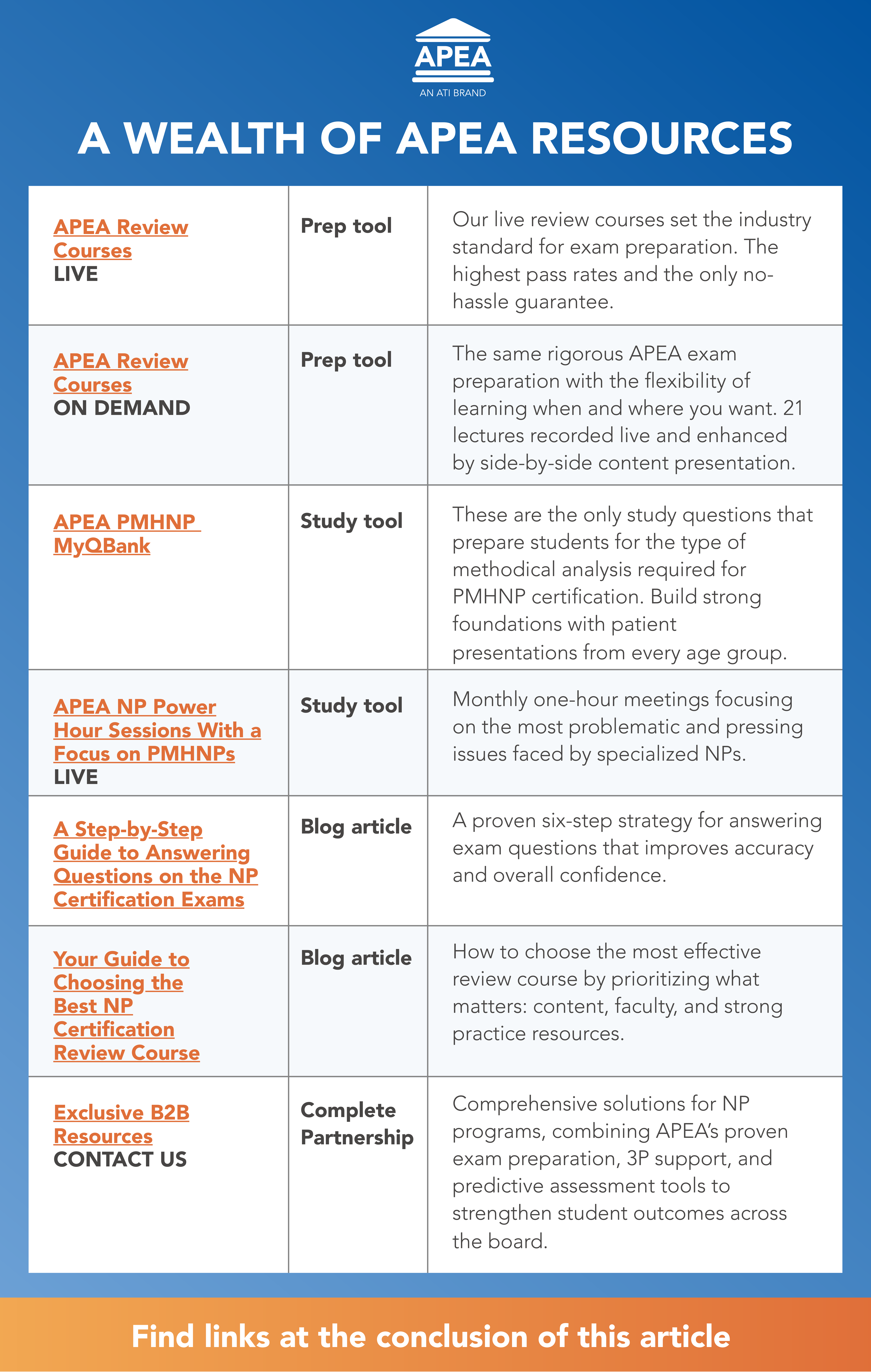
MOST COMMON MISTAKE: It’s possible for NPs to undersell the importance of a systematic approach to test-taking. It’s a common academic reflex to believe comprehensive coursework and traditional studying will inevitably lead to a passing score. In some cases, it’s enough. In many cases, it isn’t. The difference is often review courses, question banks, and other guided means of keeping the content fresh and practicing exam-style analysis.
STEP 4: Obtain a state license (for every state).
By the time they choose to specialize, most practitioners understand that licensure isn’t standardized nationwide. That said, they don’t always understand all the nuances they’ll need to consider ahead of time to end up in the care setting they prefer. Simply put, on a state-by-state level, the same degree and the same certification don’t always result in the same sort of PMHNP practice.
Each state sets its own scope of practice, prescriptive authority, and supervision requirements for PMHNPs, all of which can fundamentally alter any care setting. NPs need this information to make informed career decisions, avoid delays in licensure, and ultimately align their training with their own professional goals. For long-term success, it is absolutely essential information.
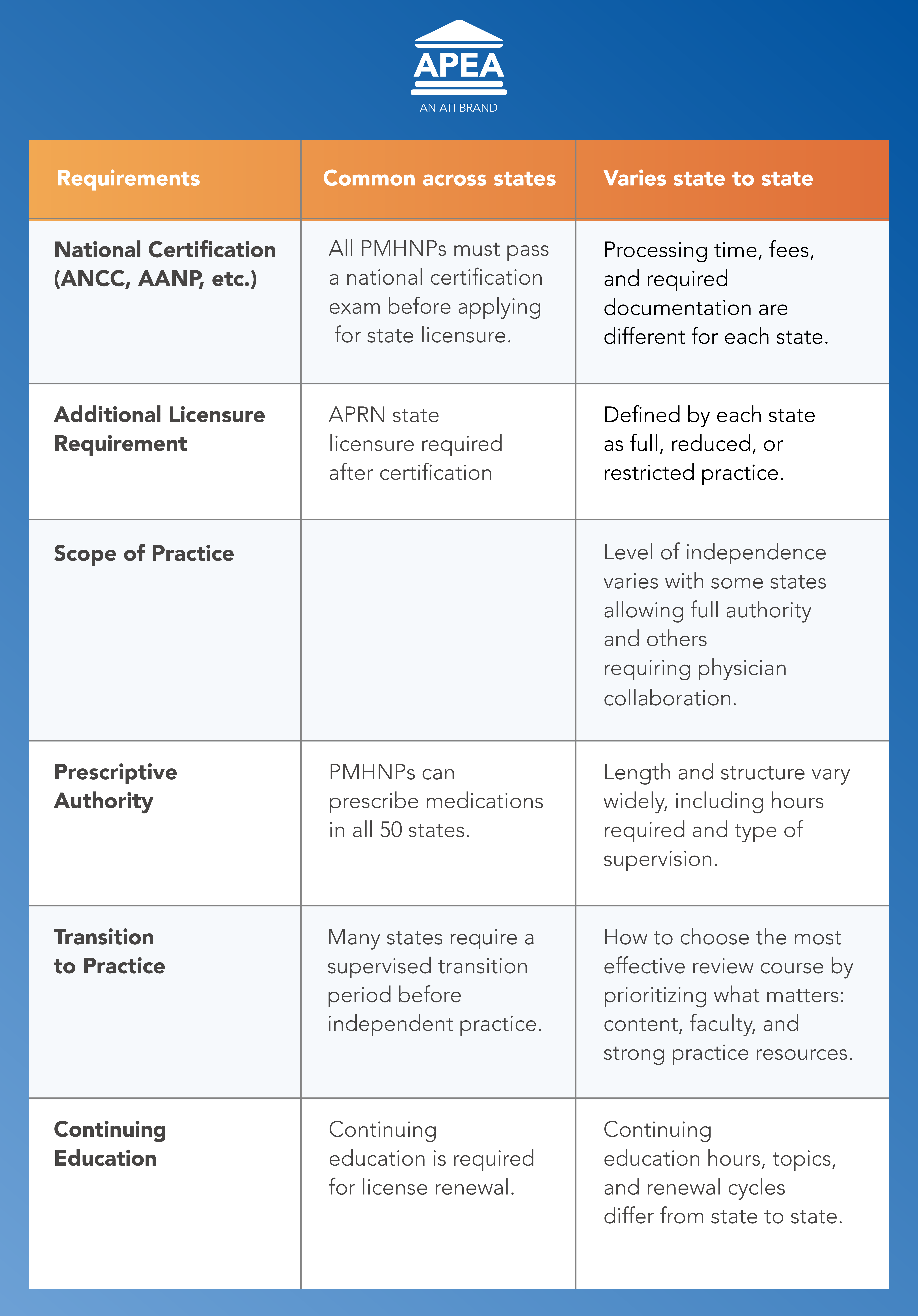
MOST COMMON MISTAKE: There’s the right information — then, there’s the right information at the right time. In this case, you need both, and some NPs only worry about the first. It simply isn’t enough to research and understand these state-by-state nuances at the last minute. For an NP to secure the type of PMHNP practice they want, they ideally need to seek out this information as part of the initial planning process.
STEP 5: Secure a collaborator and establish prescriptive authority.
Only about half of the states in the U.S. require this final step, but it has a direct impact on a PMHNP’s ability to prescribe medication—and sometimes their ability to even see patients at all. In these states, licensure grants a PMHNP permission to practice, but a collaborator relationship is what defines how they can practice.
The exact process for securing a collaborator varies from state to state, but they typically include formal written agreements and a clear definition of the scope of oversight. A range of fees. A spectrum of availability. There are many variables to the most successful collaborations.
MOST COMMON MISTAKE: It’s easy for an aspiring PMHNP to underestimate just how critical this step can be. Many states enforce a collaborator dependency that becomes a real barrier to psychiatric treatment access if agreements collapse.⁵ Still, at its best, this relationship can produce better long-term patient outcomes.⁶ That’s why successful PMHNPs plan ahead, researching state requirements, identifying potential collaborators, and initiating paperwork well before their intended start date.
Then, never stop learning.
Continuing education (CE) is an integral part of being a successful PMHNP—not only because of mandatory state requirements, but because of the obligation inherent in healthcare professionals staying current and capable.
APEA’s CE library can be an ongoing resource for NP students and primary care NPs. This includes the most recent PMHNP Review Course and Clinical Update, the NPACE Mental Health, Advanced Pharmacotherapeutics, and Precision Medicine Bundle, and the NPACE Mental Health Bundle. Earn the contact hours you need with the focus and schedules you need to succeed.
-------
Looking for the links mentioned above? Details about APEA's extensive resources are always just one click away.
- LIVE APEA Review Courses
- ON DEMAND APEA Review Courses
- APEA PMHNP MyQBank
- APEA NP Power Hour Sessions
- A Step-by-Step Guide to Answering Exam Questions
- Your Guide to Choosing the Right Review Course
- Exclusive Program Resources CONTACT US
REFERENCES
- American Association of Colleges of Nursing. Schools of nursing see enrollment increases across most program levels, signaling strong interest in nursing careers. Published January 2025. https://www.aacnnursing.org/news-data/all-news/article/schools-of-nursing-see-enrollment-increases-across-most-program-levels-signaling-strong-interest-in-nursing-careers-1480
- Kohl LG. Transitioning from family nurse practitioner to psychiatric mental health nurse practitioner: challenges and strategies for success. Yale School of Nursing Digital Theses. Published 2020. https://elischolar.library.yale.edu/cgi/viewcontent.cgi?article=1154&context=ysndt
- Gordon M, Johnson K, Smith L. Barriers to psychiatric nurse practitioner clinical training: preceptor shortages and clinical placement challenges. Journal for Nurse Practitioners. Published online 2023. https://www.npjournal.org/article/S1555-4155(23)00320-3/fulltext
- Chatburn E, Kreitzer M, Davidson PM. Competency-based clinical education in advanced practice nursing: shifting from hours to outcomes. Nursing Outlook. Published online 2026. https://www.nursingoutlook.org/article/S0029-6554(26)00092-8/fulltext
- Muxworthy H, Bowllan N. Barriers to practice and impact on care: an analysis of the psychiatric mental health nurse practitioner role. St. John Fisher College. Published online 2007. https://dor.org/tasks/sites/home/assets/File/Barriers%20to%20Practice-1.pdf
- Kane RL, Shamliyan TA, Mueller C, Duval S, Wilt TJ. Nurse practitioner care compared with physician care: a systematic review. Journal of the American Medical Directors Association. 2004;5(6):362-372. doi: 10.1016/j.jamda.2004.09.012