The NP Preceptor Shortage: Understanding Barriers and Why Student Preparedness Matters
- Oct. 15, 2026
Share:
There's good news. The Bureau of Labor Statistics projects nurse practitioner employment to grow much faster than the national average.¹ Unfortunately, there's also bad news. A specialized workforce demands a specialized pipeline, and NP education is struggling to meet the skyrocketing demands of the healthcare industry.
Not surprisingly, the clinical preceptor shortage is a big part of the problem.
Fewer preceptors means fewer practice-ready professionals. In fact, the American Association of Colleges of Nursing (AACN) directly links nursing programs turning away qualified applicants to faculty and preceptor shortages.² What’s more, recent research suggests the situation is even more problematic for nurse practitioners with the rise of paid preceptorships and a general disregard for NP preceptors since the upheaval of COVID-19.³
Simply put, there aren’t enough preceptors to support the NP pipeline, and those who are actively engaged in position are finding it increasingly difficult to keep up with demand.
Why? The answer is complicated. There are many barriers to preceptor participation. Some big, some small. Some personal, some systematic. However, it’s clear that underprepared NP students are a compounding factor for preceptor dissatisfaction and eventual burnout.⁴
This shortage has no simple solution. That said, among the many barriers being placed around preceptor participation, student preparedness remains one of the few things NP programs can directly control. When preceptors are already balancing patient care, documentation, and outside productivity demands, the level of student preparation can make all the difference.
And maybe solve its own part of the preceptor problem.
A Growing Challenge for NP Programs
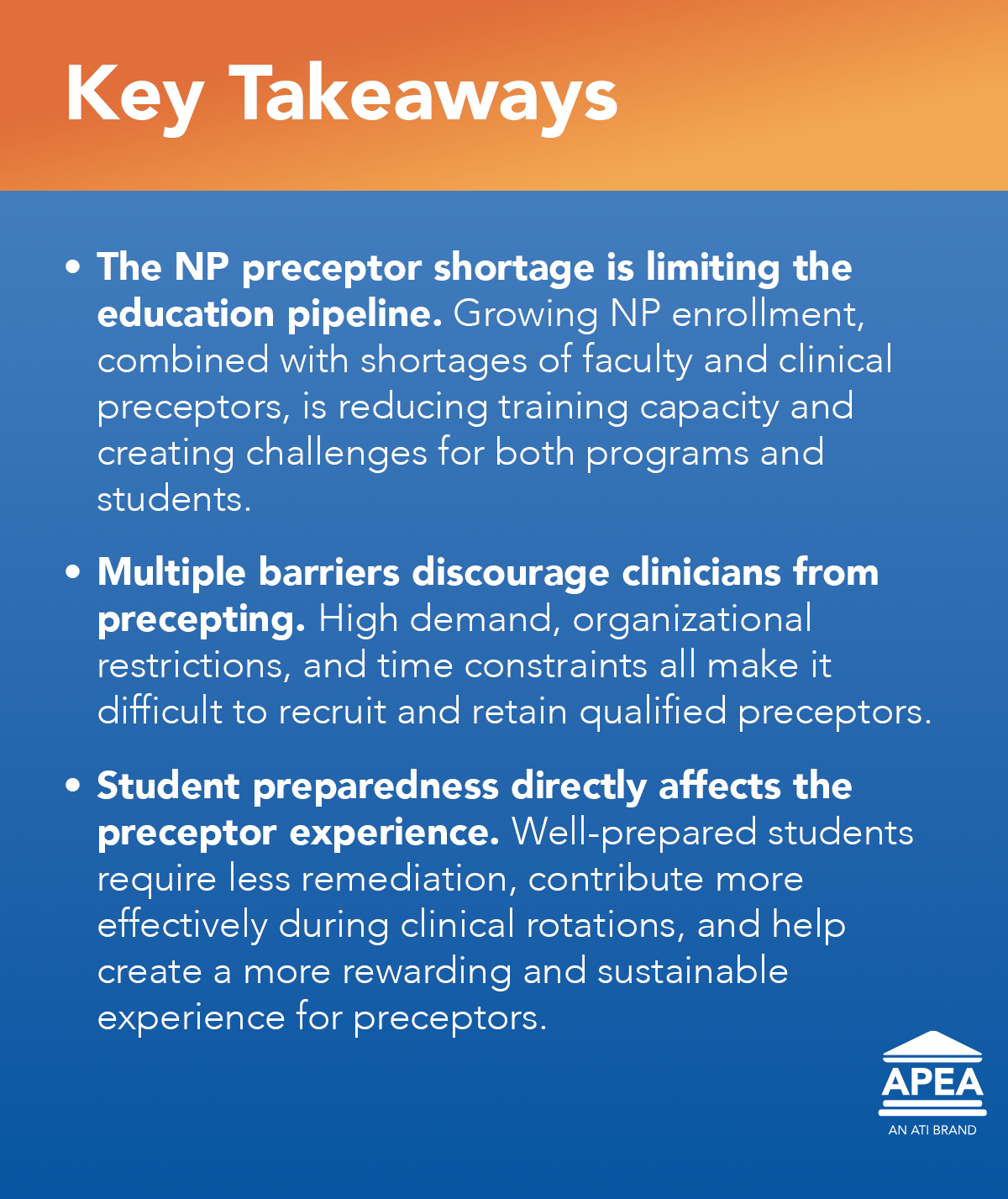
One of the biggest challenges facing successful programs due to the preceptor shortage is a bit of a double-edged sword. In a sense, they are too popular. The number of aspiring NPs is increasing at a rapid rate, placing growing pressure on NP programs, clinical sites, and an already limited preceptor pool.
That’s why surveyed NP programs consistently name “preceptor and clinical site requirements” as one of their greatest challenges.⁵ And to make matters worse, the AACN recently found that over 16,000 qualified applicants were turned away from master’s and doctoral programs in just one year.² That means fewer sites, fewer preceptors, and fewer future faculty—all while the need for NPs is growing.
Meanwhile, clinical placements for active NP students have become an increasingly shared burden. Many faculty report spending large portions of their time searching for available preceptors for students, and some surveys suggest 40% of NP students end up securing their own clinical placements.⁵ No matter the perspective, preceptor availability remains an "unpredictable" part of the process.⁶
Somehow, everyone is working to find placements, but the shortage is only getting worse.
A Growing Challenge for Students
That shortage is changing the student experience.
An NP student’s clinical experience shapes the future of their practice. That hasn’t changed. Clinical rotations are where students build confidence and cultivate the judgment and reasoning skills that will define them as practitioners.
What has changed is what the “search” for a preceptor looks like. The time. The money. The scarcity. The compromise. The preceptor shortage hasn’t just made it more difficult for NP students to secure qualified preceptors. It’s made the start-to-finish journey for an aspiring NP more daunting overall.
How?
- More responsibility for students. Finding a preceptor has become a major part of the NP journey.
- More student-related stress. A highly competitive search means more personal and financial strain.
- More potential for delays. Pauses in progress can disrupt graduation timelines and timely clinical placement.
- More compromise from students. Getting the location and role you want is increasingly difficult.
But students only see the end result of the challenge, the consequences of the real problem. To understand why these experiences have become increasingly common, we need to examine the barriers blocking preceptor participation in the first place.
The 4 Barriers to Preceptor Participation
The NP preceptor problem isn't as straightforward as a simple shortage. After all, there are plenty of great clinicians practicing across the country. In this case, the question isn't "Where are all the great clinicians?" Instead, the question is "Why don't great clinicians become preceptors?"
The answer is barriers — four major barriers to preceptor participation that keep some of the very best practitioners from offering guidance to the next generation.
1. Too much demand
What's the simplest explanation for the severity of the preceptor shortage? The number of students looking for preceptors keeps going up. For NP programs, that means more applications and more students. But from a clinician's perspective, that translates into something very different: more requests, more competition, and more pressure to choose who they can realistically support.
2. Too many restrictions
Even clinicians who want to precept may be unable to do so. Many healthcare organizations have policies that place heavy restrictions on student placements or on-site supervision. Kathy Baldridge, DNP, FNP-BC, APEA’s Lead NP Education Specialist, describes these policies and procedures as the invisible barrier to preceptor participation.
"Often, the biggest barrier isn't the clinician's willingness to teach. It's the fiscal impact and organizational policies that make precepting difficult to support,” Dr. Baldridge said. “A provider may want to take a student, but their organization may have productivity requirements, restrictions on student involvement in patient care, or administrative requirements that make it difficult to say yes."
3. Too little time
Being an active preceptor takes time, and time is increasingly difficult to come by.
Today's clinicians are balancing patient care with mountains of documentation. As mentioned previously, some clinicians even face strict productivity expectations from their organization, and it's making it increasingly difficult to precept. In fact, according to a recent report from the National Advisory Council on Nurse Education and Practice (NACNEP), time pressures and productivity demands are one of the biggest challenges to preceptor recruitment.⁷
4. Too many students who aren't ready
The preceptor experience is only as good as its students, and many new arrivals are falling short. More specifically, around 25% of new nurses aren't confident in their clinical care.⁸ That same troublesome transition is creating similar challenges for new NPs.⁹
Why? Because student readiness isn't about memorizing information. It demands critical thinking and professionalism with a strong foundation in advanced pathophysiology, pharmacology, and physical assessment. When students show up ill-equipped and unprepared, the entire clinic suffers—patients and clinicians alike.
These barriers create complex and multi-faceted challenges to NP preceptor participation. Many of them are systematic and require comprehensive change to really see an impact. That said, student preparedness is one issue where NP programs can make a serious difference, and many successful programs are doing their part to send NP students to clinicals prepared to contribute.
Student Preparedness and the Preceptor Experience
NP programs can't reshape the workforce. They can't remove organizational restrictions. They can't make good clinicians want to be preceptors.
However, they can help NP students arrive better prepared, which means a better preceptor experience and more clinical preceptors in the near future. And that preparedness starts with the 3Ps: advanced pathophysiology, pharmacology, and physical assessment.
A solid, reliable house is only as strong as its foundation. The same is true of a safe, competent nurse practitioner. The 3Ps are core competencies and affect every aspect of downstream education, including the breadth of a practitioner’s working knowledge and their moment-to-moment clinical decision making.
Of course, knowledge itself is just a small part of being a successful NP. More importantly, this knowledge forms the foundation of the critical thinking and clinical judgment that will be used in real patient situations. After all, today's NPs have plenty of online resources to find the information they need. What they don't have is a website or an app that replaces the reasoning required to turn that information into safe clinical decisions.
As Dr. Baldridge says, "A good critical thinker doesn't know everything. They recognize what they don't know, know where to find the answer, and use their reasoning to take the next logical step."
It's true that student preparedness can't solve the preceptor problem on its own. But it can help create the kind of clinical experience that makes precepting more rewarding and more sustainable. When students arrive with strong 3P foundations, sound critical thinking skills, and a commitment to professionalism, preceptors can spend less time filling knowledge gaps and more time developing their future colleagues.
APEA and the Future of the NP Workforce
The solutions to the preceptor shortage aren't simple. According to the NACNEP, they include preceptor-specific training, faculty-focused databases, and new financial initiatives for faculty development across the board.⁷ Each of these efforts is a lifelong campaign in and of itself, but those aren't the only means of improving the status quo.
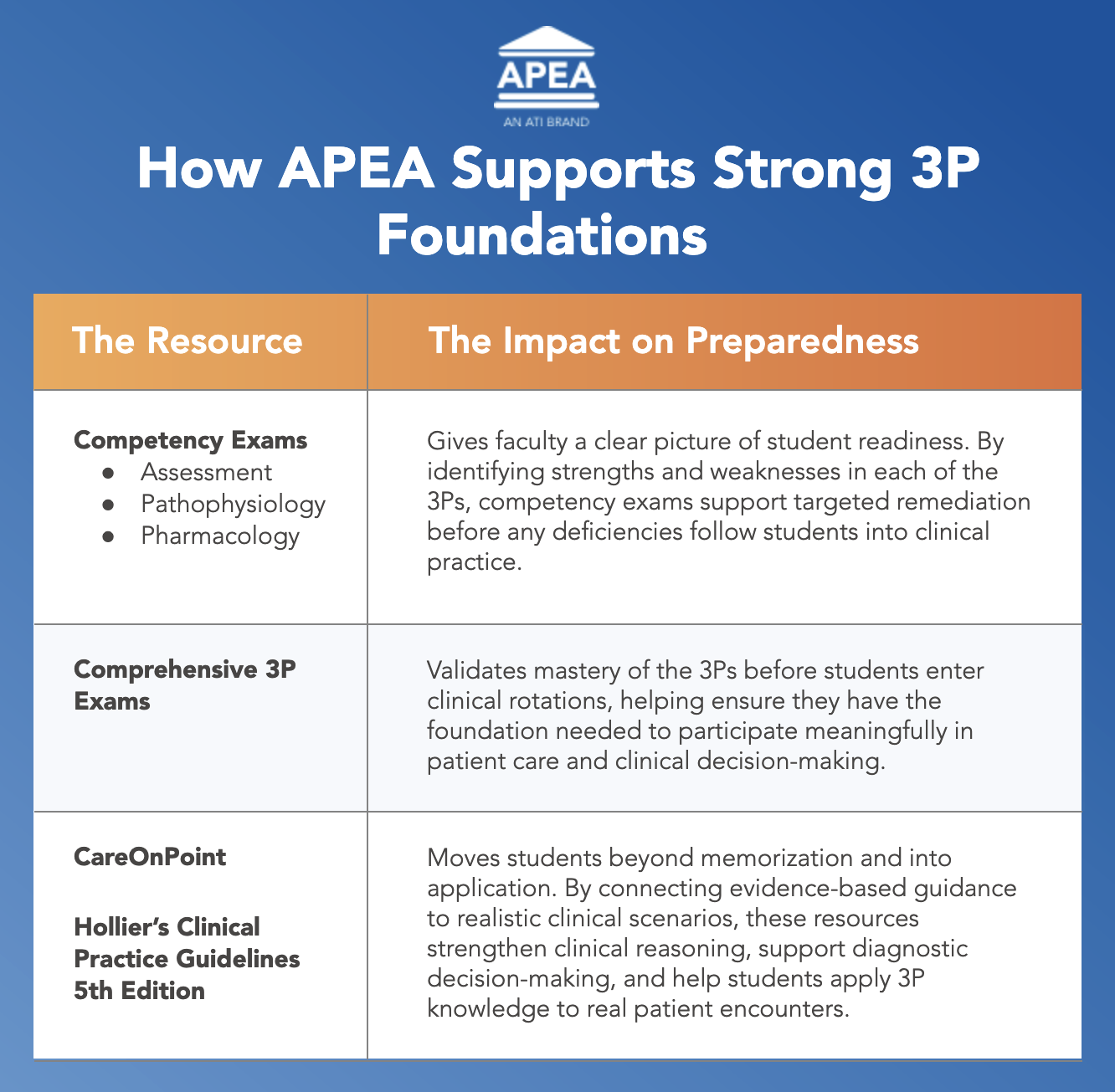
APEA services and solutions are designed to strengthen NP candidates — from their academic foundations to their clinical readiness. This means more prepared students and a better preceptor experience.
What’s the underlying problem? Students transition to clinical settings without the foundational 3P knowledge needed for effective clinical reasoning. The result is more remediation, more frustration, and fewer opportunities for preceptors to focus on higher-level learning. What’s the solution? Preparing students long before they enter the clinic.